
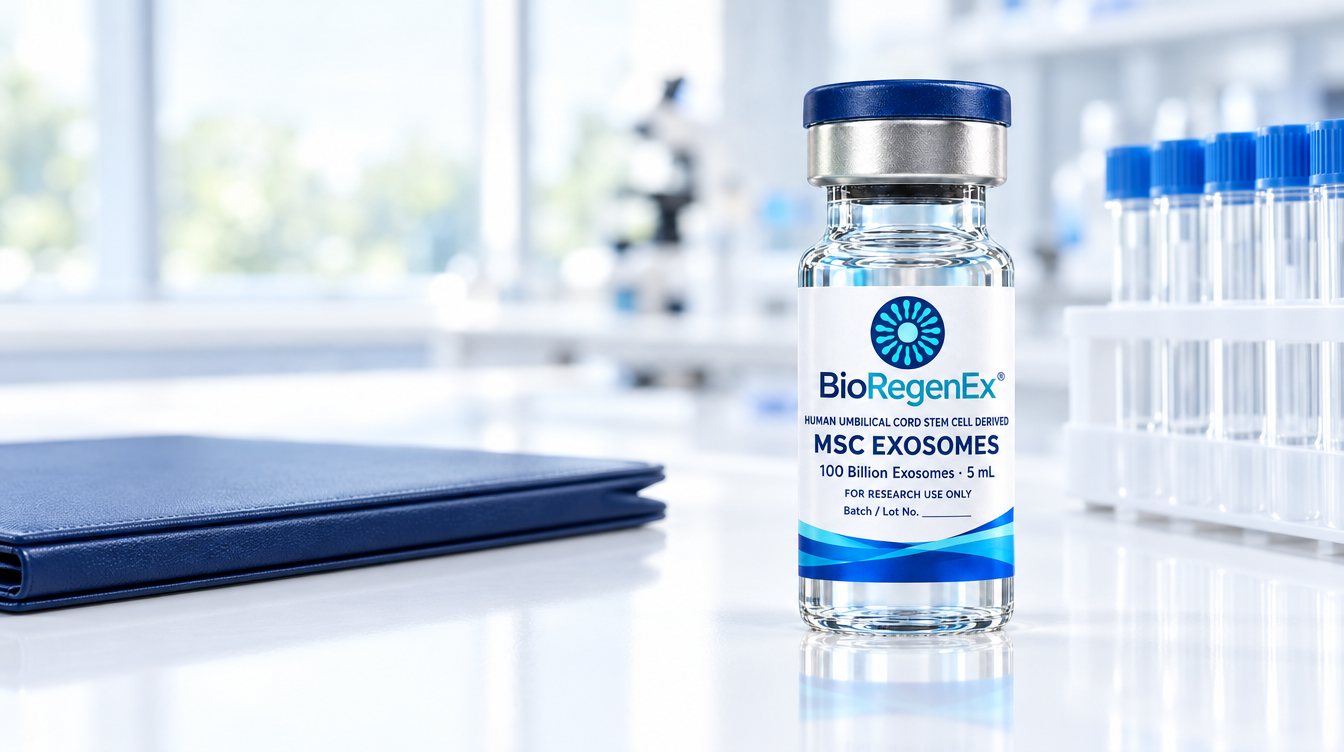
Lyophilized vs Frozen MSC Exosomes: What the Research Shows
Cold chain is one of the quieter operational burdens in extracellular vesicle (EV) research. Frozen material requires validated freezers, temperature monitoring, and shipping on dry ice, and every freeze-thaw cycle introduces a question about whether the preparation that reaches the bench is the same one that left the manufacturing facility. Freeze-drying, or lyophilization, is the obvious alternative: remove the water, store the solid at refrigerator temperature, and reconstitute at the point of use. The research literature suggests this is achievable for MSC-derived vesicles, but only under specific formulation conditions, and the supporting data remain largely preclinical and in vitro.
Why Water Removal Is Not a Neutral Step
Lyophilization subjects vesicles to two separate stresses. Freezing concentrates solutes and can form ice crystals that mechanically disrupt a lipid bilayer, and the subsequent drying step removes the hydration shell that helps keep membrane and protein structures in their native conformation. Either stress can produce aggregation, membrane rupture, or loss of the functional cargo that makes a preparation biologically interesting in the first place. This is why formulation work in this area centers on lyoprotectants — typically disaccharides or sugar alcohols added before drying.
What Formulation Studies Have Found
A 2018 study examined whether EVs could survive freeze-drying and whether they could protect an enzyme cargo through the process. MSC vesicles isolated by ultracentrifugation followed by size-exclusion chromatography were held for 14 days at minus 80 degrees Celsius, at 4 degrees, at room temperature, or lyophilized without additives. Particle counts in the MSC EV preparations did not change significantly across those conditions, and the increase in measured size after drying did not reach significance, though electron microscopy showed broader size distributions and occasional aggregates. The functional readout told a more cautious story: drying without an additive reduced bioactivity, while adding trehalose at 1% or 4% restored activity to levels the authors described as comparable to frozen storage. Trehalose and mannitol at 0.5% to 4% improved stability, mannitol above 4% raised apparent particle counts in a way the authors attributed to sugar crystals, and polyethylene glycol caused aggregation.
A 2022 study in Pharmaceutics approached the problem from a manufacturing angle, developing a lyophilized MSC-derived acellular preparation. Bone marrow MSC secretome product was concentrated by tangential flow filtration and buffer-exchanged into phosphate-buffered saline, 5% sucrose, 4% mannitol, or 4% trehalose, then dried under either a manifold protocol or a shelf protocol and stored at 4 degrees Celsius. The choice of drying protocol mattered considerably: vesicle and protein recovery were markedly higher with the shelf method, where sucrose and mannitol performed best and mannitol was best overall. Mean vesicle diameters were similar before and after drying in the sugar formulations. Lyophilized trehalose-formulated material protected a hepatocyte line against an oxidative challenge, with no detectable difference from fresh material.
Reading These Results Honestly
Several limitations deserve emphasis. Both studies used in vitro functional assays, so they speak to retained activity in a dish rather than to any outcome in a living system. Neither established a shelf life: the 2022 study reported storage at 4 degrees without specifying a duration, and the 2018 study followed a 14-day window. The 2018 authors explicitly noted that vesicle-associated RNA, including miRNA, was not assessed, which is a meaningful gap given that nucleic acid cargo is central to the proposed mechanisms of MSC vesicles. Sample sizes were small. And the two studies disagreed on which sugar performed best, which is the expected result when formulation performance depends on the starting material, the buffer, and the drying cycle rather than on the excipient alone.
The broader field reflects this. The 2025 MSC-EV review in Frontiers in Cell and Developmental Biology lists standardized production among the unresolved problems in translating these products, alongside dosing and repeated-dose toxicity. Formulation and storage sit squarely inside that standardization problem.
Practical Implications for Research Clinics
For investigators evaluating material, a few points follow from the published work. A lyophilized format is not self-validating; the relevant question is what data exist for that specific product, dried by that specific cycle, in that specific excipient. Useful documentation includes post-reconstitution particle count and size distribution rather than pre-drying figures alone, a defined reconstitution volume and diluent, and a stated storage condition with the duration over which it was tested. Where a potency or functional assay exists, post-reconstitution results are more informative than particle counts, a point we discuss in our article on why particle counts fall short as a potency measure. Our guidance on storing and handling research-grade exosomes covers cold-chain practice for frozen material.
It is also worth noting that formulation choices interact with the isolation process upstream. Co-isolated protein and buffer composition both influence how a preparation behaves during freezing and drying, which means the manufacturing record and the formulation record should be read together.
Where This Leaves the Question
The available evidence supports a measured conclusion: freeze-drying appears compatible with retention of vesicle integrity and in vitro bioactivity when an appropriate lyoprotectant and drying cycle are used, and it appears to degrade activity when they are not. That is a formulation-dependent finding, not a general property of lyophilized vesicles, and it has not been established in clinical use.
There are no FDA-approved exosome products. BioRegenEx supplies MSC-derived exosomes for research use only, cGMP-manufactured in an FDA-registered United States facility and ethically sourced from human umbilical cord (Wharton's Jelly) MSCs. Specifications and documentation for current research formats are available through our exosome research overview.
References
- Frank J, Richter M, de Rossi C, Lehr CM, Fuhrmann K, Fuhrmann G. Extracellular vesicles protect glucuronidase model enzymes during freeze-drying (2018)
- Driscoll J, Yan IK, Patel T. Development of a Lyophilized Off-the-Shelf Mesenchymal Stem Cell-Derived Acellular Therapeutic. Pharmaceutics, 2022;14(4):849
- Zhang T, Zhang L, Ma X, Song W. The tiny giants of regeneration: MSC-derived extracellular vesicles as next-generation therapeutics. Frontiers in Cell and Developmental Biology, 2025;13:1612589
These statements have not been evaluated by the U.S. Food and Drug Administration. BioRegenEx exosome products are provided for research use only and are not intended to diagnose, treat, cure, or prevent any disease. There are no FDA-approved exosome products. Any treatment decision is made solely between a patient and a licensed healthcare provider.