
FDA Exosome Warning Letters 2025-2026: Lessons for Clinics
Between August 2025 and August 2026, the FDA's Center for Biologics Evaluation and Research (CBER) issued a series of warning letters to companies and clinics marketing exosome, Wharton's Jelly and umbilical cord products. Read together, the letters show a consistent enforcement pattern. For physicians and research clinics evaluating suppliers, they are one of the most practical primary sources available, because they show exactly what the agency looks at and what it objects to.
The Letters at a Glance
Five publicly posted letters were reviewed for this article: Platinum Biologics (August 2025), New Life Medical Services (September 2025), Dynamic Stem Cell Therapy (February 2026), Blue Horizon International (May 2026) and R3 Medical Companies, including Bello Bio and Regen Suppliers (August 2026). All five came from CBER's compliance office, and all five involve products described as exosomes or extracellular vesicles, usually alongside umbilical cord or Wharton's Jelly products.
The recipients differ. Some are manufacturers or distributors, and others are clinics offering treatments directly to patients. The legal reasoning, however, is nearly identical from one letter to the next.
The Core Finding: Drugs and Biologics Without Approval
In each letter, FDA concludes that the products are drugs under the Federal Food, Drug, and Cosmetic Act and biological products under section 351 of the Public Health Service Act. Products in that category require an approved biologics license application (BLA) to be marketed, or an investigational new drug application (IND) to be studied in humans. None of the firms had either. There are no FDA-approved exosome products.
The February 2026 letter contains the clearest general statement. In it, the agency explains that, as a general matter, exosomes intended to diagnose, treat, mitigate or prevent disease, or to affect the structure or function of the body, are subject to premarket review and approval. Several letters also refer readers to FDA's public safety notification on exosome products, which describes reports of serious adverse events.
For umbilical cord and Wharton's Jelly products, the letters walk through the criteria in 21 CFR 1271.10(a) and find that the products fail on minimal manipulation, homologous use, or both. Our overview of the 361 vs 351 HCT/P classification explains why those two criteria matter so much.
Marketing Claims Establish Intended Use
A striking feature of the letters is how much of the evidence comes from websites, social media and training videos. FDA quotes statements about joint pain, neuropathy, autoimmune disease, neurological conditions, hair restoration and anti-aging, and treats them as evidence of what the product is intended to do.
The lesson for clinics is that intended use is judged from the whole picture: the supplier's website, sales materials, social posts, and what representatives say on video. General language about tissue repair or reducing inflammation was quoted in the letters just as disease-specific claims were. A label alone does not settle the question if the surrounding marketing points toward patient treatment.
Manufacturing and Identity Problems
The August 2026 letter is the most detailed on manufacturing. It cites deviations from current good manufacturing practice in areas including aseptic process controls, written production procedures, laboratory controls, quality unit responsibilities, and donor screening. It also notes that an expiration period had been assigned without supporting stability data.
That same letter raises a point researchers should not overlook. In footnotes, FDA observes that the manufacturing process used for certain products sold as exosomes did not appear capable of isolating exosomes at all. In other words, the name on the vial and the contents may not match. This is why independent characterization data matters. Our guide on how to read a Certificate of Analysis for MSC exosomes describes the size, marker and sterility results a buyer should expect to see.
Practical Takeaways for Physicians and Research Clinics
First, be cautious with any supplier whose materials describe treating, reversing or relieving a medical condition. Those are the statements FDA quoted most often.
Second, ask how the material is made and tested. Request lot-specific documentation covering particle size and concentration, identity markers, sterility, endotoxin and stability, and ask whether the manufacturing facility operates under cGMP.
Third, understand that clinics are not insulated. Two of the five letters went to clinics rather than manufacturers, based largely on the clinic's own website content.
Fourth, recognize what legitimate human investigation requires. Administering an exosome product to patients for a disease or condition calls for an IND and appropriate oversight. Research-use-only material is intended for laboratory and preclinical work, and the designation does not by itself authorize clinical use. Our article on exosome therapy covers the current state of the evidence in more detail.
Where BioRegenEx Stands
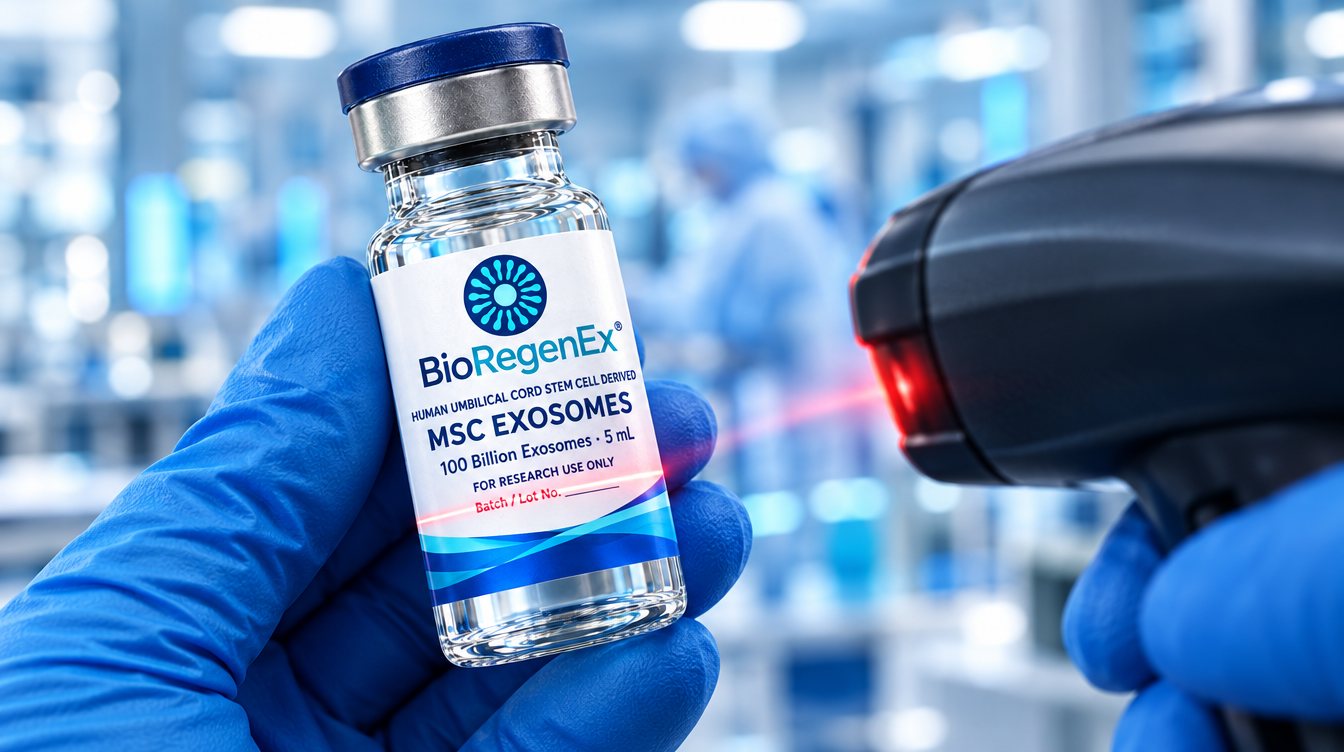
BioRegenEx supplies MSC-derived exosomes for research use only. Our material is cGMP-manufactured in an FDA-registered U.S. facility and ethically sourced from human umbilical cord (Wharton's Jelly) MSCs, with lot-specific documentation available to qualified researchers. Facility registration is not product approval, and we make no treatment claims. We encourage every buyer to read the FDA letters directly; the links are below.
References
- FDA Warning Letter: R3 Medical Companies (August 14, 2026)
- FDA Warning Letter: Blue Horizon International, LLC (May 26, 2026)
- FDA Warning Letter: Dynamic Stem Cell Therapy (February 11, 2026)
- FDA Warning Letter: New Life Medical Services, LLC (September 24, 2025)
- FDA Warning Letter: Platinum Biologics LLC (August 15, 2025)
These statements have not been evaluated by the U.S. Food and Drug Administration. BioRegenEx exosome products are provided for research use only and are not intended to diagnose, treat, cure, or prevent any disease. There are no FDA-approved exosome products. Any treatment decision is made solely between a patient and a licensed healthcare provider.